
Top 8 Plan A Alternatives in 2026
Quick Summary: Plan A is a well-regarded name in European carbon accounting, but it isn't the right fit for every business. If you need a platform that's genuinely easy to adopt, priced for your scale, and backed by hands-on expert support — there are stronger options available. We've rounded up the 8 best alternatives, with Emerald Power leading the way as the standout choice for Irish and UK SMEs and mid-market companies who need accuracy, simplicity, and real support without the enterprise price tag.
If you've been evaluating Plan A and found yourself wondering whether there's a more accessible, more cost-effective, or better-supported alternative — you're not alone. A growing number of businesses, particularly SMEs and mid-market companies navigating CSRD obligations, investor reporting requirements, and supply chain due diligence, are finding that Plan A's enterprise-skewing model doesn't map well onto their reality.
This guide walks you through eight Plan A alternatives worth considering in 2026 — what each platform does well, where it falls short, and who it's actually built for.
Why Trust Us?
We haven't just read the marketing pages. At Emerald Power, we've spoken to hundreds of users across different carbon reporting platforms — finance directors, sustainability leads, operations managers, and CFOs — to understand what works in practice and what creates friction.
We've also sat on demos of these platforms ourselves. As we've built and refined Emerald Power, we've made it our business to understand exactly what competing tools offer, how they handle complex data, and where they leave users without adequate support. That hands-on perspective shapes every comparison below.
Our goal is simple: help you make a confident, well-informed decision — not to push any platform for its own sake, but to be honest about what each tool actually delivers and who it genuinely serves. Check out our article about picking the right carbon accounting software for your business.
Why Consider a Plan A Alternative?
Plan A is a credible platform in the carbon accounting market, and for mid-to-large European businesses with dedicated sustainability teams and the budget to match, it delivers. But as more SMEs and mid-market companies face CSRD obligations and supply chain pressure to report, a number of consistent limitations have emerged from real user feedback across G2, Capterra, and independent review sites.
Here's what users and analysts are actually saying.
- Pricing that doesn't work at SME scale Plan A's pricing is not publicly listed — a recurring frustration flagged by reviewers and noted even by competitors like Greenly. What is clear from market analysis is that Plan A sits firmly in the mid-market-to-enterprise pricing bracket, with platforms of its type typically ranging from €20,000 to €100,000+ annually. For smaller businesses without large sustainability budgets, this creates an immediate barrier to entry. As one independent analyst noted, Plan A "is a good choice for companies who want to invest in a cutting-edge carbon accounting tool with high-end features, and have the budget to match." That qualifier — and have the budget to match — is the critical caveat for most SMEs evaluating the platform.
- Not designed for smaller businesses Multiple independent sources flag that Plan A's interface and feature depth are calibrated for large enterprises, not SMEs. One competitor analysis noted directly that "Plan A may not be suitable for small and medium-sized enterprises, as its interface is more conducive for large enterprises." For lean teams without a dedicated sustainability function, this translates into a steeper onboarding curve and a greater reliance on internal resource to get value from the platform.
- A complex setup for teams without sustainability expertise While Plan A's AI-powered data management is designed to speed up carbon reporting — the platform claims up to 70% faster data collection versus manual methods — this benefit is most accessible to teams that already understand what they're reporting. For businesses earlier in their sustainability journey, the platform's depth can feel overwhelming rather than enabling. Without in-house carbon accounting knowledge, getting from implementation to a reliable, audit-ready report requires significant support — and that support comes at a cost.
- The service model can feel advisory-heavy relative to software value Plan A's model pairs platform with dedicated sustainability experts, which is a genuine strength for the right client. But for businesses that primarily need reliable software they can operate themselves — without ongoing advisory dependency — the model can feel like paying for a consultancy wrapped around a tool. Some users find that the advisory layer, while valuable, makes the total cost of ownership harder to justify compared to platforms offering strong expert support at no additional fee.
- Less transparent than some alternatives Lack of public pricing is a known frustration. Unlike some competitors who offer clear, upfront pricing on their websites, Plan A requires prospective customers to go through a sales process before understanding what they'll pay. For busy finance directors and sustainability leads trying to build a business case quickly, that friction is a real drawback. Check out our carbon accounting pricing guide here.
The Top 8 Plan A Alternatives at a Glance
| Platform | Best For | Ease of Use | Audit-Ready Accuracy | Expert Support | SME / Mid-Market Fit |
| Emerald Power (Top Pick) | SMEs and mid-market companies | Excellent | GHG Protocol-aligned & audit-ready | Dedicated expert team | Purpose-built |
| Greenly | SMBs and European mid-market | Good | Strong methodology | Good onboarding | Good fit |
| Normative | Science-led mid-market teams | Good | TÜV SÜD verified | Climate advisors available | Good fit |
| Sweep | Collaborative teams & larger orgs | Good | Strong data integrity | Onboarding support | Leans enterprise |
| Watershed | Data-heavy large organisations | Moderate | Enterprise-grade | Specialist support | Enterprise-skewing |
| Persefoni | Financial services & enterprise | Complex setup | Financial-grade audit trail | Enterprise support | Not SME-oriented |
| Coolset | European mid-market CSRD compliance | Good | TÜV certified | Good support | Good fit |
The 8 Best Plan A Alternatives in 2026
1. Emerald Power
Our Top Pick
Best for: SMEs & mid-market companies that need accuracy, simplicity, and expert backup.
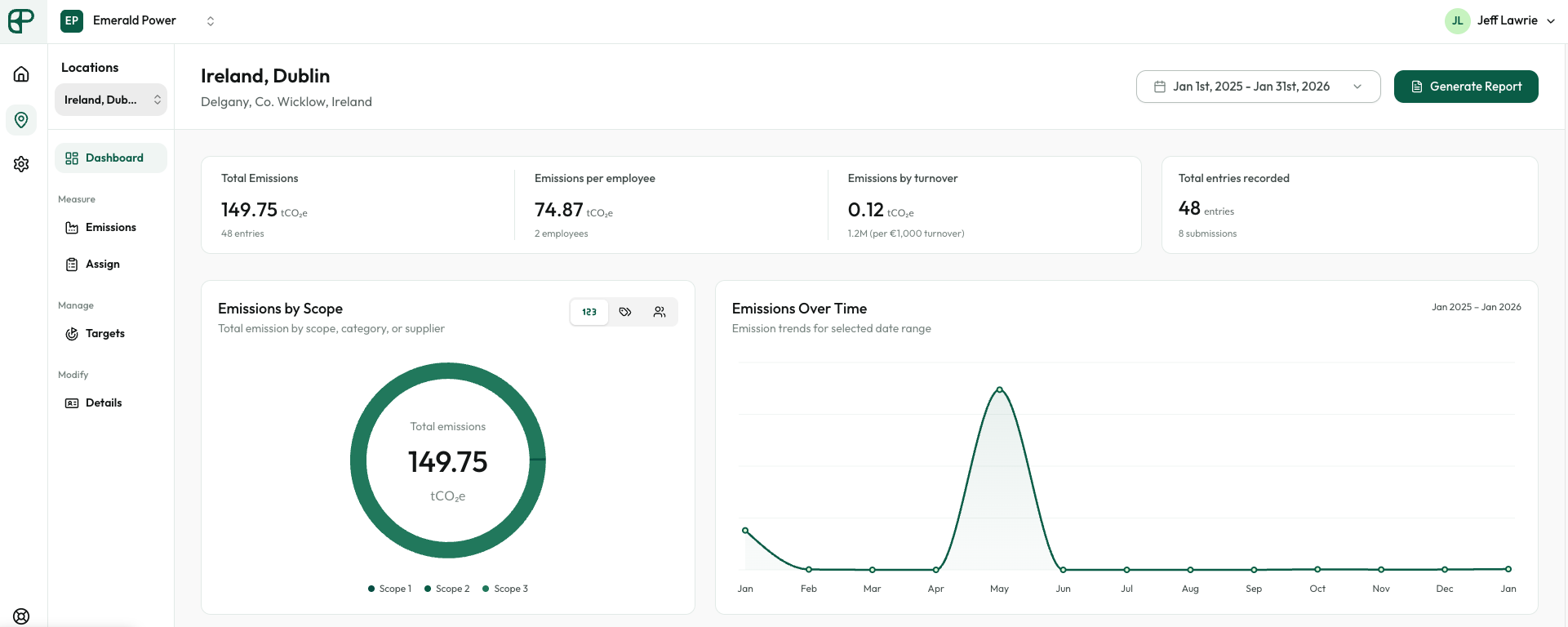
If you've landed on this page searching for a Plan A alternative that actually fits a business like yours — one that isn't an enterprise solution built for companies with dedicated sustainability teams and six-figure software budgets, but also isn't a basic tool that leaves you guessing at audit time — Emerald Power is the first platform worth looking at seriously.
Emerald Power was built specifically for the Irish and UK SME and mid-market segment. That means the platform has been designed around the realities of businesses with lean sustainability teams (or none at all), complex Scope 3 supply chains, and an increasing need to produce reports that stand up to scrutiny from auditors, banks, and investors alike.
Three things set Emerald Power apart in this market: its genuinely intuitive platform that reduces the time-to-first-report dramatically; its advanced methodology that produces GHG Protocol-aligned, audit-ready figures from day one; and its expert support team — real sustainability specialists who work alongside you, not a chatbot pointing you to a help article.
Where Plan A's model works best for organisations that can justify the cost of a dedicated carbon accountant and advisory overlay, Emerald Power delivers the expert guidance as part of the package — without requiring you to pay enterprise rates for the privilege. As your CSRD obligations grow, as your investors ask harder questions, and as your supply chain data becomes more complex, the platform is built to handle it — without requiring you to become a carbon accounting expert yourself.
Strengths
- Purpose-built for SMEs and mid-market — not a scaled-down enterprise tool
- GHG Protocol-aligned, audit-ready outputs from day one
- Intuitive UI — minimal training required
- Dedicated expert support team (humans, not bots)
- Transparent, SME-friendly pricing
- Strong Scope 1, 2 & 3 coverage including supply chain
- Designed for Irish & UK regulatory context
Limitations
- Newer to market than some global incumbents
- Less suited to very large multinationals needing global data centres
Bottom line: If you're an SME or mid-market company in Ireland or the UK looking for a platform that's easy to adopt, accurate enough to satisfy auditors, and backed by real experts at a price that makes sense — Emerald Power is the most natural fit on this list.
2. Greenly
Best for: SMBs and European mid-market businesses seeking a well-known platform with broad ESG coverage.
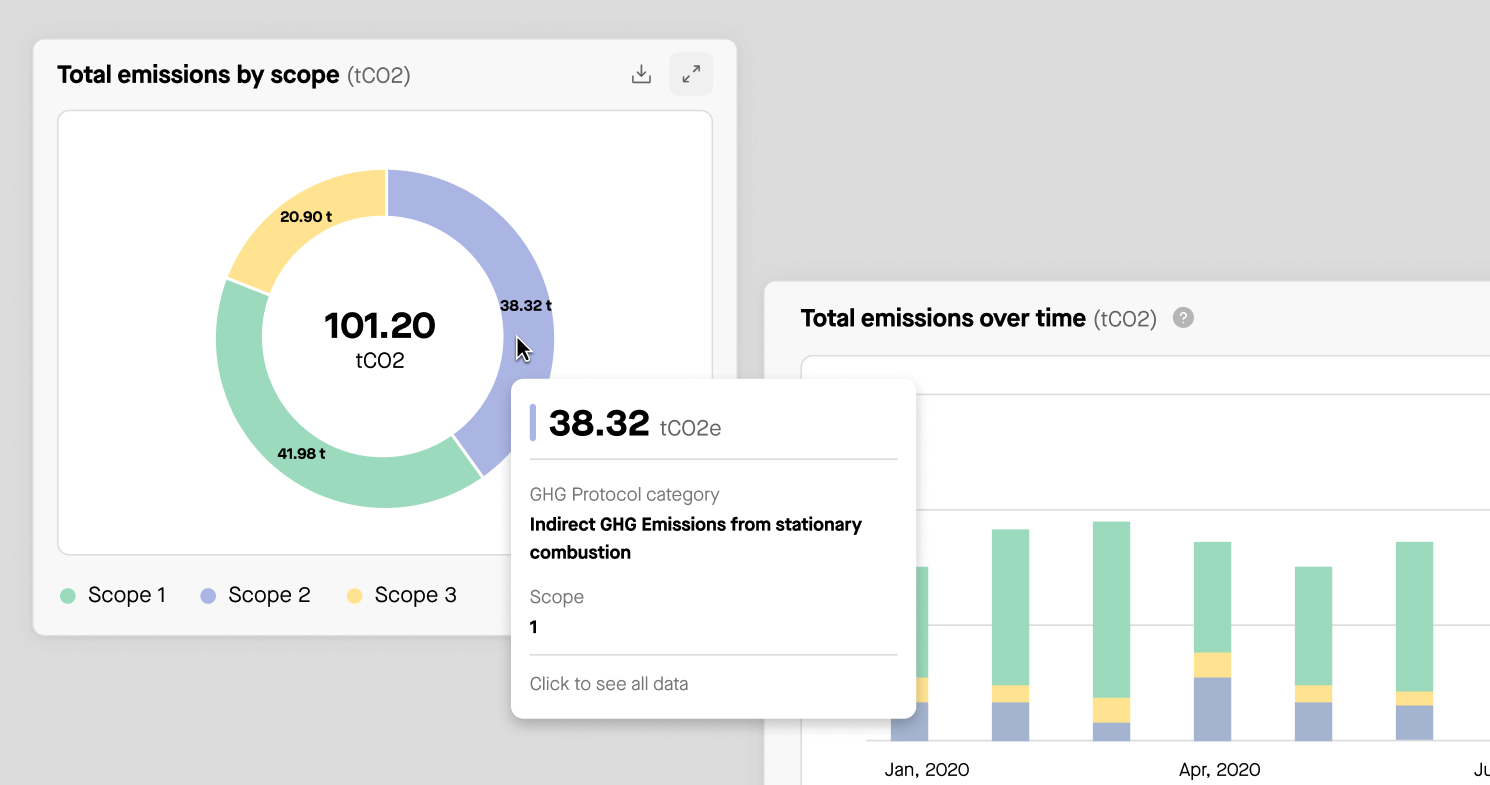
Greenly is one of the better-known names in European carbon accounting, founded in Paris in 2019 and built around the goal of making emissions measurement accessible to businesses that don't have large sustainability teams. For companies earlier in their reporting journey, Greenly offers a recognisable starting point — a structured approach to Scope 1, 2, and 3 measurement with a reasonably intuitive interface.
Where Greenly distinguishes itself from Plan A is in its accessibility positioning and its broader ESG data coverage beyond pure carbon. For businesses that need to report across multiple sustainability dimensions, Greenly's multi-framework approach has appeal. It's also more widely known in the SME bracket than Plan A, which tends to skew toward larger organisations.
The trade-offs are real, however. Users across independent review platforms flag data accuracy concerns that require significant internal verification, limited reporting customisation, and a pricing structure that can feel difficult to justify as businesses scale. The platform's advanced features also carry a learning curve that can leave users reliant on support rather than operating confidently day-to-day.
Strengths
- Well-recognised brand in European carbon accounting
- Broad ESG and multi-framework coverage
- More accessible positioning than Plan A
- Strong Scope 1, 2, and 3 coverage
Limitations
- Reported data accuracy issues requiring internal verification
- Limited reporting customisation frustrates users with evolving stakeholder needs
- Pricing can be challenging to justify at SME scale
- Steep learning curve for users without prior carbon experience
- Software bugs flagged by users across G2 and Capterra
Not interested in Greenly? Check out some Greenly alternatives here.
3. Normative
Best for: Science-driven mid-market organisations wanting deep carbon focus and verified methodology.
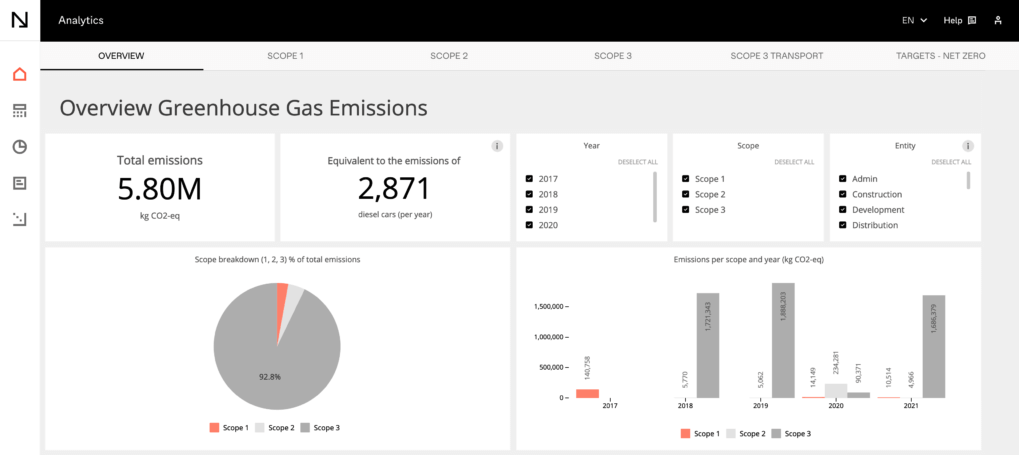
Normative is one of the original carbon accounting platforms, founded in Stockholm in 2014 and widely regarded as a pioneer in science-based emissions measurement. Its carbon accounting engine draws on over 330,000 emission factors from more than 20 scientific databases, and its methodology has been independently verified by TÜV SÜD. For organisations that place methodology and scientific rigour at the top of their priorities list — and where a 100% audit success rate matters — Normative is a credible option.
Where Normative distinguishes itself from Plan A is in the depth of its carbon focus. Unlike platforms that span the full ESG spectrum, Normative keeps its attention squarely on Scope 1, 2, and 3 carbon accounting — and does it well. Climate Strategy Advisors are available to help teams interpret results and identify reduction opportunities, which is genuinely useful for businesses without in-house sustainability expertise.
The limitation users most frequently flag is the volume of manual data entry required when feeding the platform your operational data. It can also feel narrow if your reporting requirements extend beyond carbon into broader ESG territory.
Strengths
- TÜV SÜD verified methodology — credible for audits
- Deep Scope 3 coverage across 20+ scientific databases
- 100% audit success rate claimed
- Climate Strategy Advisors included
- GRI, CDP, Nasdaq ESG export formats
Limitations
- Manual data entry heavier than some competitors
- Carbon-only focus — limited if you need full ESG
- Response times from support can be slow
4. Sweep
Best for: Larger teams wanting to embed sustainability across departments and collaborate on emissions data
Sweep, founded in Paris in 2020, is a data platform built around the idea that sustainability has to become a team effort — not something that lives in one person's spreadsheet. Its standout feature is a highly collaborative environment where different departments can contribute data, track their slice of the emissions picture, and work toward shared reduction goals. Named a Leader in the Verdantix 2026 Green Quadrant for enterprise carbon management, Sweep has grown its client base significantly among larger European organisations.
Sweep supports Scope 1, 2, and 3, has strong scenario modelling capabilities, and provides customisable dashboards that offer considerable flexibility for teams with tailored reporting needs. It also offers deep supplier engagement tools for businesses with complex Scope 3 supply chains — something Plan A also addresses, but where Sweep's collaboration-first architecture gives it an edge in multi-stakeholder environments.
Where Sweep is less compelling is for smaller teams. The platform's depth can feel like overkill for an SME that just needs a clean, reliable carbon report without extensive configuration. It's built to scale, which means it may feel like more work to get up and running than a leaner alternative.
Strengths
- Excellent multi-department collaboration tools
- Named Leader in Verdantix 2026 Green Quadrant
- Highly customisable dashboards and analytics
- Strong Scope 3 supplier engagement features
- Scenario modelling for reduction pathways
Limitations
- Can feel over-engineered for smaller teams
- Setup and configuration takes time
- Pricing leans toward larger deployments
- Less expert-led support than some alternatives
5. Watershed
Best for: Large, data-heavy organisations with complex multi-category emissions across global operations.
Watershed is a US-founded carbon management platform that has established itself as a serious enterprise-grade option, particularly for organisations managing vast quantities of emissions data across complex operations and global supply chains. Alongside Sweep, it was named a Leader in the Verdantix 2026 Green Quadrant for enterprise carbon management — a strong signal of its position at the top end of the market.
The platform integrates a built-in emissions factor database with over 500,000 emission factors to streamline Scope 3 reporting, and its ability to handle ESG disclosure alongside decarbonisation planning makes it attractive to large corporates with sophisticated sustainability functions. For enterprises managing complex emissions across multiple categories, Watershed's infrastructure holds up well.
The honest caveat: Watershed is not built for SMEs. Its pricing, implementation timeline, and the level of internal resource required to extract full value from it put it firmly in the large-organisation bracket. If you're a mid-market company or SME, the complexity and cost are likely to create more friction than value.
Strengths
- Enterprise-grade data handling and scale
- Over 500,000 emission factors
- Named Leader in Verdantix 2026 Green Quadrant
- Strong Scope 3 with supplier engagement portals
- Science-based target modelling
Limitations
- Not designed for SMEs — pricing and complexity reflect this
- Significant internal resource required
- Long implementation timelines
- US-centric origins — less tailored to European regulatory context
6. Persefoni
Best for: Financial services firms, asset managers, and large enterprises needing portfolio-level carbon analytics
Persefoni has carved out a highly specialised niche in the carbon accounting world: financial services and investment management. If you're a bank, asset manager, or private equity firm needing to measure and disclose financed emissions, Persefoni is one of the most capable platforms available. It has been built with financial-grade auditability at its core, with a robust carbon ledger model and support for frameworks including TCFD, PCAF, and SEC climate disclosure requirements.
For general businesses, however, Persefoni is a significant over-specification. The platform's complexity, pricing, and implementation effort are calibrated for large organisations with dedicated sustainability and finance teams. Its learning curve is steep — a point noted consistently by independent reviewers — and the initial data preparation process can be demanding even for well-resourced teams. SMEs and most mid-market businesses will find it difficult to justify either the cost or the internal overhead.
Strengths
- Best-in-class for financed emissions and portfolio carbon
- Financial-grade carbon ledger model and audit trail
- Strong TCFD, PCAF, and SEC framework support
- Trusted by large financial institutions
Limitations
- Not designed for non-financial businesses
- Steep learning curve — not intuitive for beginners
- Enterprise pricing is prohibitive for SMEs
- Initial setup and data preparation is time-intensive
7. Coolset
Best for: European mid-market companies prioritising CSRD compliance with an end-to-end sustainability platform.
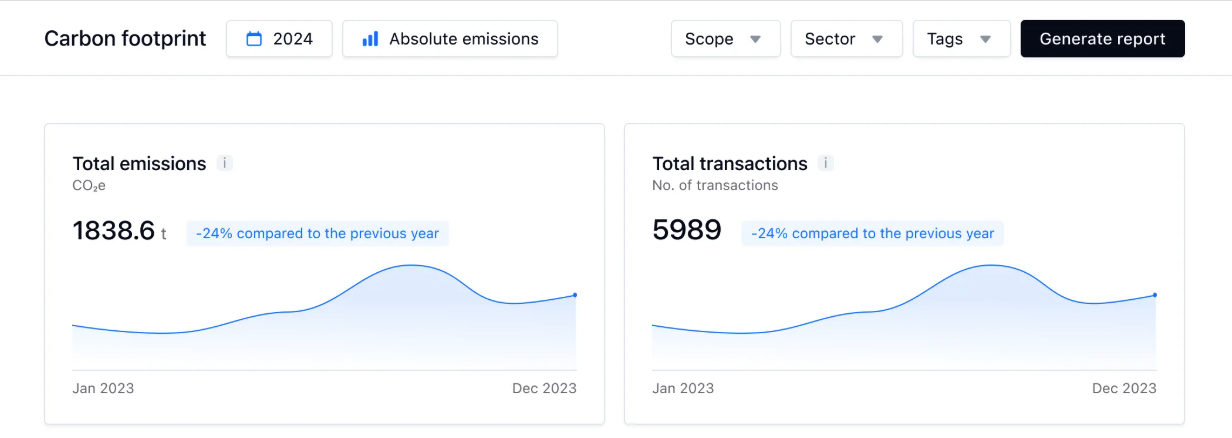
Coolset is a European carbon and ESG platform that has built a strong reputation among mid-market companies navigating CSRD requirements. It offers TÜV-certified Scope 1–3 measurement, CSRD and ESRS compliance tooling, EUDR and PPWR modules, and a built-in sustainable alternatives marketplace — giving businesses a route from measuring emissions to actively reducing them. The customisation options and reporting flexibility have been highlighted positively by users, and its support quality is generally regarded as solid.
As a direct Plan A alternative, Coolset is compelling for mid-market European businesses primarily focused on CSRD readiness. It covers similar compliance ground to Plan A while being designed more explicitly for the mid-market, without the advisory-heavy service model that makes Plan A feel expensive for some buyers. Independent analysis from Coolset's own research positions it as the "most complete and user-friendly solution for mid-market enterprises" in the Plan A alternatives space.
Coolset is less strong for businesses that need deep Scope 3 supply chain analytics or have particularly complex operational data environments. It's also a newer platform than some of the established names on this list, which may factor into long-term vendor considerations.
Strengths
- TÜV-certified Scope 1–3 measurement
- Strong CSRD, ESRS, EUDR, and PPWR compliance workflows
- Sustainable alternatives marketplace included
- Good customer support quality
- Mid-market pricing — more accessible than Plan A
Limitations
- Newer platform — less proven at scale
- Less suited to complex Scope 3 supply chain environments
- Less established brand recognition than older incumbents
8. Microsoft Sustainability Manager
Best for: Large enterprises already running Microsoft infrastructure who need sustainability data integrated into their existing tech stack
Microsoft Sustainability Manager is part of Microsoft Cloud for Sustainability and integrates carbon accounting directly within Azure and the broader Microsoft enterprise ecosystem. For large organisations that are already heavily invested in Microsoft infrastructure — Dynamics 365, Azure, Power BI — it offers a route to sustainability reporting without adding a standalone platform into the stack. It supports Scope 1, 2, and 3 measurement and can generate reports aligned with multiple disclosure frameworks.
The practical reality is that Microsoft Sustainability Manager is emphatically not an SME or mid-market tool. The implementation complexity, the requirement for existing Microsoft infrastructure, and the technical resource needed to configure and maintain it put it well beyond the reach and need of most growing businesses. The value proposition is almost entirely dependent on existing Microsoft ecosystem commitment — without it, the platform makes little sense.
Strengths
- Deep integration with existing Microsoft/Azure infrastructure
- Multiple reporting frameworks supported
- Strong data consolidation for large, complex organisations
- Trusted Microsoft brand and long-term vendor stability
Limitations
- Only compelling if already using Microsoft enterprise infrastructure
- Not designed for SMEs — significant complexity and resource required
- Requires technical implementation capability
- Limited standalone appeal outside the Microsoft ecosystem
Choosing the Right Plan A Alternative
Every platform on this list solves a slightly different version of the carbon reporting problem. The right choice depends on your organisation's size, internal capacity, regulatory obligations, and how much expert support you want alongside the software.
| If you want… | Consider.. |
| A simple, audit-ready platform with expert support and SME-friendly pricing | Emerald Power |
| A well-known brand with broad ESG coverage | Greenly |
| Deep scientific methodology and a carbon-only focus | Normative |
| Cross-department collaboration at scale | Sweep |
| Enterprise-grade global data management | Watershed |
| Portfolio-level carbon for financial services | Persefoni |
| CSRD-first compliance for European mid-market | Coolset |
But if you're an SME or mid-market company — the most common profile of a business finding that Plan A's model doesn't match their scale or budget — Emerald Power is the platform that's been built with you specifically in mind. It's the only option on this list that combines genuine ease of use, audit-grade accuracy, and hands-on expert support at a price point that makes sense for businesses at your stage.
Frequently Asked Questions
What is Plan A carbon accounting software?
Plan A is a Berlin-based carbon accounting and decarbonisation platform founded in 2017. It provides Scope 1, 2, and 3 emissions measurement, ESG reporting, and reduction planning tools, with TÜV Rheinland-certified methodology. It is primarily designed for mid-to-large European companies and counts clients including BNP Paribas, BMW, and Trivago.
Why are businesses looking for Plan A alternatives?
The most common reasons businesses look for Plan A alternatives include pricing that is difficult to justify at SME scale, a model that leans heavily on advisory services rather than self-serve software, and an interface calibrated for large enterprises rather than lean teams. Businesses without dedicated sustainability functions often find more accessible options provide better day-to-day value.
What is the best Plan A alternative for SMEs?
Emerald Power is the strongest Plan A alternative for SMEs and mid-market companies in Ireland and the UK. It offers GHG Protocol-aligned, audit-ready reporting, an intuitive platform that requires minimal training, dedicated expert support, and transparent pricing designed for businesses at this scale — without the enterprise overhead.
What is the best Plan A alternative for CSRD compliance?
For businesses primarily focused on CSRD readiness, Coolset and Emerald Power are both strong options. Coolset covers CSRD, ESRS, and adjacent EU regulatory modules. Emerald Power is particularly well-positioned for Irish and UK businesses navigating the interaction between CSRD, GHG Protocol requirements, and investor or bank reporting obligations.
Does Plan A have transparent pricing?
No. Plan A does not publish pricing on its website, which has been flagged as a frustration by prospective buyers. You need to go through a sales process to receive a quote. Several alternatives — including Emerald Power — offer more transparent pricing structures.
Ready to See Emerald Power in Action?
Book a 30-minute demo with our team. We'll walk through your current reporting setup, show you exactly how Emerald Power handles your specific data and framework requirements, and give you an honest view of whether we're the right fit.