
UAE Climate Law: Everything You Need To Know
UAE Climate Law applies to every business in the UAE — including SMEs and free zone companies — with no size or revenue threshold. The full compliance deadline is 30 May 2026. Scope 1 & 2 reporting is mandatory. Scope 3 is expected from 2027. All businesses must register on the national MRV platform (mrv.ae), submit a reduction plan, and retain records for five years. Fines for non-compliance range from AED 50,000 to AED 2,000,000 — doubling to AED 4,000,000 for repeat violations within two years. Existing voluntary sustainability reports (GRI, CDP, ESG disclosures) do not satisfy this law.
The UAE's landmark climate legislation is now in force — and it applies to your business regardless of size, sector, or where in the UAE you're registered. For the SMEs that make up the vast majority of businesses operating across Dubai, Abu Dhabi, Sharjah and the UAE's free zones, this is the most significant regulatory shift in years: from voluntary sustainability commitments to legally enforceable obligations with real financial consequences.
This guide explains exactly what the law requires, what SMEs need to do before the 30 May 2026 deadline, and how Emerald Power can help you get compliant without the complexity.
What is the UAE Climate Law?
Federal Decree-Law No. (11) of 2024 on the Reduction of Climate Change Effects was issued on 28 August 2024 and entered into force on 30 May 2025. It makes the UAE the first country in the MENA region to establish a legally binding national climate framework. Full compliance for all entities is required by 30 May 2026.
The law supports the UAE's Net Zero by 2050 strategy and its commitments under the Paris Agreement. It is overseen by the Ministry of Climate Change and Environment (MOCCAE), which sets reporting methodologies, sector-specific standards, and enforcement mechanisms. The UAE's Third Nationally Determined Contribution (NDC 3.0) commits the country to a 47% reduction in national emissions by 2035 relative to 2019 levels — providing the strategic context within which all entity-level reduction plans sit.
Does it apply to SMEs?
Yes — unambiguously. The law applies to all public and private entities in the UAE whose operations generate greenhouse gas emissions. There is no minimum size threshold, no revenue floor, and no sector exemption. Whether you are a trading company in DMCC, a logistics firm in JAFZA, a hospitality business in Dubai, or a professional services firm in Abu Dhabi, if your operations produce GHG emissions, you are in scope.
This catches many SME owners off guard. The assumption that this law targets large industrial conglomerates is incorrect. It was designed with economy-wide reach from the outset.
Key dates and deadlines
28 Aug 2024
Federal Decree-Law No. (11) of 2024 signed and published. Passed
30 May 2025
Law enters into force. All UAE businesses legally subject to its provisions from this date. In force
28 Jun 2025
Registration deadline for large emitters (≥0.5 MtCO₂e/year) with the National Carbon Credit Registry under Cabinet Resolution 67/2024. Passed
30 May 2026
Full compliance deadline for all entities — Scope 1 & 2 reporting, MRV platform registration, and reduction plan submission required. Deadline
2027 (expected)
Scope 3 reporting anticipated to become mandatory. Not yet confirmed in law — treat as expected rather than certain. Upcoming
What does the law require?
The law creates four categories of obligation for every in-scope entity.
Obligation 1
Measure & report emissions
Register on MOCCAE's national MRV platform at mrv.ae. Calculate and submit Scope 1 and 2 emissions through the Integrated Emissions Quantification Tool (IEQT). Entities in Abu Dhabi should also check requirements under the Environment Agency Abu Dhabi's parallel system.
Obligation 2
Submit a reduction plan
Provide data on current and planned emissions reduction measures, including expected outcomes. Reports should align with national targets — the UAE is committed to a 47% reduction in GHG emissions by 2035 relative to 2019 levels.
Obligation 3
Actively reduce emissions
Demonstrate active efforts through at least one of: energy efficiency improvements, clean energy adoption, protecting natural carbon sinks, carbon capture, alternatives to fluorocarbons, carbon offsetting, or integrated waste management.
Obligation 4
Retain supporting records
Keep all records supporting your emissions data for a minimum of five years. These must be accessible to MOCCAE on request. This applies to utility bills, fuel receipts, cooling records, and any data used in your GHG calculations.
What about Scope 3?
Scope 3 — emissions from your supply chain and value chain — is expected to become mandatory from 2027, though this has not yet been confirmed in law. SMEs building their measurement processes now should consider whether their approach can extend to Scope 3 when that obligation arrives. Rebuilding a reporting process under time pressure in 2027 is an avoidable cost.
Additional requirements for large emitters
Cabinet Resolution 67/2024 applies specifically to entities emitting 500,000 tonnes or more of CO₂ equivalent per year (Scope 1 and 2 combined). These businesses — classified as "Entities of Huge Carbon Emission" — were required to register with the National Carbon Credit Registry by 28 June 2025, prepare a GHG inventory aligned with ISO 14064, and obtain third-party verification from a MOCCAE-approved verifier. Most SMEs will not fall into this category, but voluntary participation in the Carbon Credit Registry is open to all.
What are the penalties for non-compliance?
Financial penalties
First violation
AED 50,000 – AED 2,000,000
Repeat violation within 2 years
Up to AED 4,000,000
Additional consequences
Licence suspension, exclusion from government procurement
Voluntary ESG reports are not enough
If your business already produces a sustainability report — whether aligned to GRI, CDP, TCFD, or another framework — that does not satisfy UAE Climate Law. The regulation requires registration on the national MRV platform, structured submission through the IEQT, a formal reduction plan, and records maintained in a format accessible for regulatory review. A narrative ESG disclosure will not be sufficient to demonstrate compliance.
What this means in practice for SMEs
Most UAE SMEs already hold the raw data needed to build a compliant emissions inventory — it exists in utility bills, fuel receipts, cooling records, and transport logs. The challenge is not whether the data exists but whether it has been organised, calculated, and submitted in the right format.
The good news is that Scope 1 and 2 emissions for a typical SME are relatively straightforward to measure: electricity consumption, fuel use, company vehicles, and refrigerants cover the majority of sources for most businesses. A structured, one-time setup process followed by an annual data collection routine is all that is required to maintain ongoing compliance.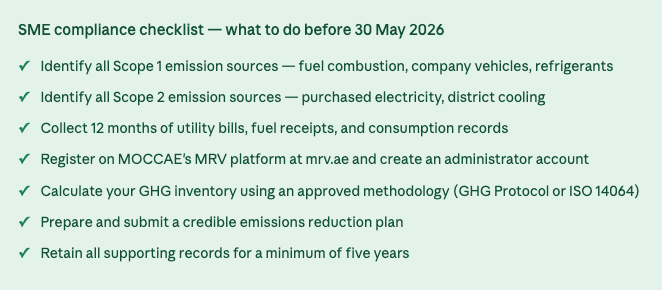
How Emerald Power supports UAE SMEs with climate law compliance
Emerald Power is purpose-built for SMEs navigating carbon reporting for the first time. We combine straightforward software with hands-on support from UAE-based sustainability experts — so you get a compliant, auditable carbon footprint without building an in-house team or working through complex frameworks alone.
Get compliant before the May 2026 deadline
- Emerald Power guides UAE SMEs through every step of UAE Climate Law compliance — from your first emissions calculation to MRV platform registration and reduction planning.
- Measure Scope 1 and 2 emissions quickly, with support from UAE sustainability experts
- Generate an auditable GHG inventory aligned with GHG Protocol and MOCCAE requirements
- Build a credible reduction plan tailored to your business size and sector
- Prepare for Scope 3 reporting requirements expected from 2027
Frequently asked questions
We're a small business. Does UAE Climate Law really apply to us?
Yes. The law contains no minimum size, revenue, or headcount threshold. If your UAE operations produce greenhouse gas emissions — from electricity consumption, fuel use, vehicles, or cooling — you are in scope. This includes mainland businesses, free zone companies, and state-owned enterprises of all sizes.
What is the MRV platform and how do we register?
The MRV platform is MOCCAE's national Integrated Emissions Quantification Tool (IEQT), accessible at mrv.ae. Registration involves creating an account, assigning data provision and validation roles within your organisation, and receiving approval from the relevant emirate-level focal point. The platform then guides you through emissions calculation and annual inventory submission. Entities in Abu Dhabi should also check whether a parallel process applies through the Environment Agency Abu Dhabi.
We already produce a sustainability report. Does that count?
No. Voluntary ESG reports aligned to GRI, CDP, TCFD, or other frameworks do not constitute compliance with UAE Climate Law. The law requires specific procedural steps — registration on the national MRV platform, structured submission through the IEQT, and a formal reduction plan. Narrative sustainability disclosures sit entirely outside these requirements.
What methodology should we use to calculate our emissions?
Internationally recognised frameworks — particularly the GHG Protocol and ISO 14064 — provide the methodological foundation most businesses should use. These are consistent with what MOCCAE's platform is designed to receive. Whatever methodology you use must be documented and auditable, particularly as the law requires records to be retained and accessible for regulatory review for at least five years.
Do we need third-party verification of our GHG inventory?
Not unless your Scope 1 and 2 emissions exceed 500,000 metric tonnes of CO₂ equivalent per year — the threshold that classifies an entity as a "Huge Carbon Emission Entity" under Cabinet Resolution 67/2024. For most SMEs, third-party verification is not currently a legal requirement. That said, building a well-documented, auditable inventory from the outset is the right approach regardless — it makes future assurance straightforward and protects you in the event of a regulatory review.
We're registered in a free zone. Are we included?
Yes. The law explicitly applies to free zone entities across the UAE. Scope is determined by whether your operations generate GHG emissions, not by your legal or commercial registration structure. If you have facilities, staff, fleet, or energy consumption in the UAE, you are in scope regardless of your free zone status.
What happens if we miss the 30 May 2026 deadline?
Administrative fines for non-compliance range from AED 50,000 to AED 2,000,000 for a first violation, doubling to AED 4,000,000 for repeat offences within two years. Additional consequences can include licence suspension and exclusion from government procurement. With the deadline approaching, beginning the process now — rather than treating it as a mid-2026 scramble — is the only sensible approach.