
NHS Evergreen Update: No Plan, No Bid
How the NHS just changed the rules for every supplier in healthcare
On 6 April, a quiet but significant line in the sand was drawn in healthcare procurement. The NHS Evergreen Level 1 standard went live — and with it, a new rule: every supplier submitting a tender to NHS Supply Chain must demonstrate a Carbon Reduction Plan and a net-zero commitment. No plan, no bid.
That sentence is worth sitting with. Not "larger suppliers." Not "contracts above a certain value." Everyone.
The bar is now universal. Small contracts, large contracts, every supplier — the requirement is the same.
Carbon Reduction Plans aren't a new concept in NHS contracting. They've been part of larger procurement frameworks for a while now, quietly raising expectations for the biggest players. What's changed with Evergreen Level 1 is the scope. The threshold has been removed. If you want to sell to the NHS — whether you're a multinational device manufacturer or a regional consumables supplier — sustainability credentials are no longer optional.
I've been watching procurement evolve as a sustainability lever across several healthcare systems over the past few years. Regulators and commissioners have increasingly used the point of purchase as a forcing function for environmental standards. But the NHS keeps pushing further than most, and faster.
This isn't just a compliance tick-box exercise either. The logic is straightforward: the NHS is one of the largest healthcare systems in the world, with procurement spend running into the tens of billions annually. If sustainability requirements attach to that spend, they reach deep into supply chains that most environmental policies would never touch. The lever is enormous.
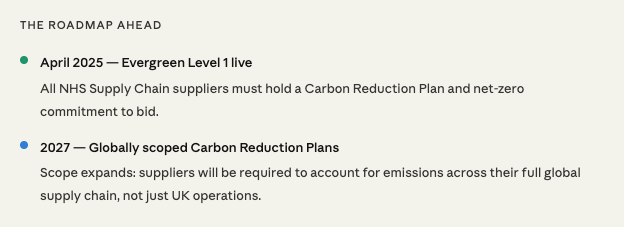
That last point — globally scoped Carbon Reduction Plans from 2027 — is where the real strategic implication lands. Domestic emissions reporting is one thing. Mapping and disclosing emissions across a global supply chain is a fundamentally different kind of undertaking. Supplier relationships, raw material sourcing, logistics partners: all of it will need to come into view.
For companies supplying healthcare across Europe, the question is already shifting. It's no longer enough to have a sustainability strategy sitting in a slide deck for the investor relations team. The question is: can you prove it at the point of sale? Can you produce a plan, on demand, as a condition of winning a contract?
The question is no longer "do we have a sustainability strategy?" It's "can we prove it when the contract depends on it?"
That's a meaningful shift in accountability. Sustainability commitments that live in annual reports are easy to make and hard to verify. Sustainability commitments that are a prerequisite for revenue are something else entirely.
The NHS has essentially introduced market consequences for greenwashing — or at least for the absence of substance behind the language. And given how closely other European health systems watch what the NHS does on procurement innovation, this is unlikely to stay contained to the UK.
If you're supplying healthcare in Europe and you haven't mapped your carbon position, the window to treat this as a future concern is closing. The organisations that treat Evergreen Level 1 as the start of a genuine process — rather than a compliance hurdle to clear once — will be better placed when the 2027 requirements land.
The NHS has made its direction of travel clear. The question for suppliers is whether their own roadmap is keeping pace.