
How To Pick The Best Carbon Accounting Software For Your Business
Carbon accounting software is no longer a nice-to-have — it is a business-critical tool for any organisation serious about measuring, managing and reducing its environmental impact. But with dozens of platforms now crowding the market, choosing the right one can feel overwhelming. The wrong choice leads to wasted investment, compliance gaps, and reporting that fails to stand up to scrutiny.
This guide sets out the key questions every procurement team, sustainability lead and CFO should be asking before committing to a carbon accounting platform. From data quality and automation to commercial models and supplier engagement, these are the criteria that separate genuinely capable software from polished marketing.
At a Glance: Key Criteria for Choosing Carbon Accounting Software
Before diving deeper, here is a summary of the eight areas this guide covers and why each one matters:
| Evaluation Area | What to Look For | Why It Matters |
| Standards & Framework Coverage | GHG Protocol, SECR, SBTi, ISSB alignment | Ensures reports are credible, compliant and audit-ready |
| Scope Coverage | Scope 1, 2 and all relevant Scope 3 categories | Incomplete scope coverage produces misleading footprints |
| Emissions Factors | Regularly updated, multi-database, sector-specific where available | Stale or generic factors reduce accuracy and credibility |
| Measurement & Reduction Approach | Structured journey from footprint to ongoing improvement | Software should drive action, not just produce numbers |
| Supplier Engagement | Direct data submission, low-burden data collection tools | Scope 3 accuracy depends on supply chain participation |
| Data Management & Automation | Automated ingestion, cleansing, categorisation | Reduces consultant hours and enables repeatable reporting |
| Integrations & Data Collection | ERP, finance, HR, travel, procurement, freight | Eliminates manual data gathering and reduces error |
1. Standards, Frameworks and Regulatory Alignment
The credibility of any carbon report depends on the frameworks underpinning it. Before evaluating any other feature, confirm which standards the platform formally supports.
Which reporting frameworks and standards does the solution align with?
The baseline expectation for any serious platform is full alignment with the GHG Protocol Corporate Standard — the globally accepted methodology for measuring and reporting greenhouse gas emissions across Scopes 1, 2 and 3. Beyond that, look for support for:
SECR (Streamlined Energy and Carbon Reporting) — mandatory for large UK companies
SBTi (Science Based Targets initiative) — essential for organisations setting or validating net-zero targets
ISSB (International Sustainability Standards Board) / IFRS S2 — the emerging global baseline for climate-related financial disclosures
CDP (Carbon Disclosure Project) — widely used for investor-grade disclosure
TCFD (Task Force on Climate-related Financial Disclosures) — increasingly embedded in regulatory requirements across the UK, EU and beyond
EU CSRD / ESRS — critical for companies operating in or reporting into the EU
A platform that only supports one or two of these creates a compliance ceiling. As regulatory requirements evolve — and they are evolving rapidly — you want a provider that is actively tracking and incorporating new obligations, not playing catch-up.
Does the platform support full greenhouse gas accounting across all relevant scopes?
Full Scope 1 and Scope 2 coverage is the minimum. The real differentiator — and the area where most organisations face both the greatest challenge and the greatest opportunity — is Scope 3.
The GHG Protocol defines 15 Scope 3 categories, from purchased goods and services through to end-of-life treatment of sold products. Ask the provider to confirm which categories are fully supported, which are partially supported, and which require workarounds or manual inputs. Common gaps include:
- Category 1: Purchased goods and services
- Category 3: Fuel and energy-related activities
- Category 11: Use of sold products
- Category 15: Investments
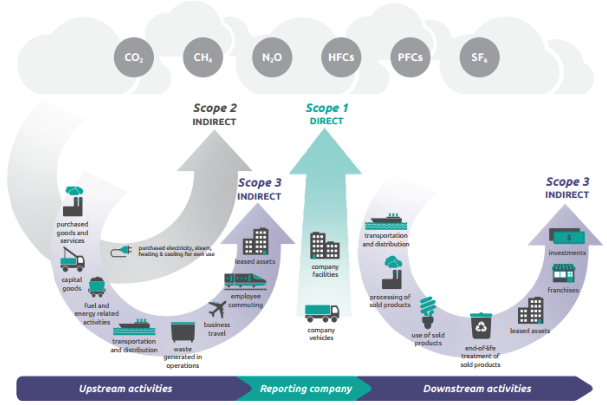
If a provider is vague about Scope 3 category coverage, treat this as a red flag.
2. Emissions Factors: Sourcing, Maintenance and Quality
Emissions factors are the backbone of any carbon calculation. The quality, currency and granularity of the factors a platform uses directly determines the reliability of the output.
Which databases and reference sources are used?
Leading platforms draw from multiple authoritative sources, including:
DEFRA / UK Government Conversion Factors — updated annually for UK-based reporting
IPCC Assessment Reports — for global warming potential values
EPA (US Environmental Protection Agency)
IEA (International Energy Agency) — particularly for electricity grid emissions
Ecoinvent — detailed life cycle inventory database widely used in Europe
Exiobase / WIOD — for spend-based Scope 3 calculations
A platform relying on a single database, or one that cannot name its sources, is not ready for serious use.
How frequently are factors reviewed and refreshed?
Emissions factors change. Grid electricity emissions intensities shift as renewables penetration increases. DEFRA publishes updated UK conversion factors every June. A platform should be updating its factor library at minimum annually, and ideally in near real-time for factors that fluctuate more frequently (such as market-based electricity factors).
Ask specifically: when a factor is updated, are historical calculations automatically recalculated or flagged for review? The answer will tell you a great deal about how seriously the provider takes data integrity.
How does the provider balance generic and sector-specific factors?
Generic spend-based emissions factors produce estimates. Activity-based, sector-specific or supplier-specific factors produce measurements. A quality platform will:
- Default to the most granular factor available for a given activity
- Allow users to input supplier-specific emissions data where available
- Clearly distinguish between estimated and measured data in reporting outputs
- Progressively improve accuracy as more primary data becomes available
3. Approach to Emissions Measurement and Reduction
Carbon accounting software should do more than generate a number. It should support an ongoing management process — from initial footprint through to verified reductions and target achievement.
What is the recommended journey from footprinting to improvement?
A well-designed platform supports a structured maturity pathway:
Phase 1 — Initial Footprint: High-level assessment using spend-based or estimated data to establish a baseline and identify the most material emission categories. This phase should be achievable quickly and without extensive data collection.
Phase 2 — Activity-Based Data Collection: Targeted data collection in the highest-impact areas, replacing estimates with measured activity data (energy bills, fleet records, freight manifests, procurement data).
Phase 3 — Reduction Planning: Identification of priority reduction opportunities, scenario modelling, and alignment of initiatives with science-based targets.
Phase 4 — Ongoing Management: A repeatable, annual (or continuous) reporting cycle with improving data quality, verified reductions and external assurance readiness.
Ask the provider to walk you through how this journey looks within their specific platform — including what is automated, what requires consultant input, and how long each phase typically takes.
How does the provider support engagement with suppliers and wider value chains?
Scope 3 Category 1 (purchased goods and services) is frequently the largest single source of emissions for non-manufacturing businesses. Engaging suppliers is therefore not optional — it is essential.
A capable platform will provide:
- Supplier portal or data submission tool — allowing suppliers to input their own emissions data directly, removing the burden from the customer's team
- Standardised questionnaires aligned with CDP Supply Chain or similar frameworks
- Automated outreach and follow-up workflows to improve supplier response rates
- Strategies for low participation scenarios — including the use of industry-average factors as proxies for non-responding suppliers, with clear disclosure of methodology
Critically, the system should not create excessive reporting burden for suppliers. If participating requires a supplier to adopt new software or learn a complex process, response rates will be low. Look for platforms with lightweight, accessible supplier engagement mechanisms.
4. Data Management, Automation and Quality
This is where marketing claims are most frequently tested against reality. Many platforms present themselves as highly automated; in practice, many still require significant consultant-led data preparation effort.
How does the platform handle fragmented or inconsistent data?
Most organisations do not have clean, centralised data. Energy data sits in multiple supplier portals. Fleet data lives in spreadsheets. Travel data is in expense management systems. Procurement data is in ERP systems that were not designed with emissions reporting in mind.
A production-ready platform must be able to:
- Ingest data from multiple sources and formats (CSV, Excel, API, direct integration)
- Identify and flag inconsistencies, duplicates or outliers
- Categorise transactions and activities automatically using AI or rule-based logic
- Handle partial or incomplete datasets without breaking the reporting workflow
What level of manual intervention is typically required?
Be direct with providers on this question. Ask for a realistic estimate of staff hours required for initial implementation and for each subsequent reporting cycle. Ask for case studies or customer references that can speak to actual effort levels — not best-case scenarios.
What evidence can the provider offer regarding automation in practice?
The most credible providers will be able to demonstrate:
- Automated data ingestion from connected systems with minimal manual touchpoints
- AI-assisted categorisation that improves accuracy over time as it learns from user corrections
- A repeatable, annual reporting process rather than a one-off consulting engagement
- Measurable reduction in data preparation time compared to spreadsheet-based approaches
If a provider cannot provide specific metrics or reference customers on these points, the automation claims should be treated with caution.
5. Integrations and Data Collection
The breadth and quality of a platform's integration ecosystem directly determines how much manual effort is required to collect and prepare emissions data.
What integrations are available?
A comprehensive platform should support integrations across:
ERP systems (SAP, Microsoft Dynamics, Oracle, Sage)
Finance and accounting platforms (Xero, QuickBooks, NetSuite)
HR and payroll systems — for headcount-based estimations and commuting data
Travel and expense tools (Concur, Expensify, TravelPerk)
Procurement platforms — for supply chain spend analysis
Utility and energy management systems
Spreadsheet import — as a fallback for data not yet connected via API
For each integration, confirm whether it is a live, bi-directional API connection or a periodic manual export. Live integrations significantly reduce ongoing effort and improve data timeliness.

For travel and logistics emissions, what specific capabilities exist?
Freight and logistics are disproportionately complex for many organisations. Confirm whether the platform can:
- Calculate emissions from subcontractors and third-party logistics providers using carrier-specific or route-specific data
- Account for international freight across sea, air and road, including multimodal journeys
- Incorporate imported materials and their embedded upstream emissions
- Handle data in carrier-provided formats (fuel statements, distance reports) rather than requiring data re-entry
6. Data Completeness and Estimation
No organisation has perfect data. A platform's approach to data gaps is as important as its handling of complete datasets.
How are data gaps identified and flagged?
The platform should provide clear, ongoing visibility of data completeness — ideally at a category and supplier level — so that teams can prioritise data collection efforts where they will have the greatest impact on accuracy.
Where only spend data is available, how are estimates generated?
Spend-based emissions estimation is an established methodology for situations where activity data is unavailable. However, the quality of spend-based estimates varies significantly depending on:
The granularity of the emissions intensity factors applied (sector-level vs. sub-sector-level)
The accuracy of transaction categorisation (which product or service category does a given spend item map to?)
The ability to use AI or machine learning to improve categorisation when supplier descriptions are incomplete or ambiguous
Ask specifically: when an invoice description reads "professional services" or "miscellaneous supplies", how does the platform determine which emissions factor to apply? The answer reveals whether the system is genuinely intelligent or simply applying broad averages.
What level of confidence or accuracy can be expected with limited source data?
A trustworthy provider will be honest about the limitations of spend-based estimates and will present uncertainty ranges alongside estimates where appropriate. Overconfident reporting based on poor underlying data is worse than acknowledged uncertainty — it creates compliance and reputational risk when figures are scrutinised.
7. Forecasting and Scenario Analysis
Backwards-looking reporting is only part of the picture. A carbon management platform should also support forward-looking planning.
What forecasting capabilities are available?
Look for the ability to:
Project future emissions trajectories based on current trends, planned growth and committed reduction initiatives
Model the impact of specific interventions — for example, switching to electric vehicles, installing solar PV, or changing procurement practices
Map against net-zero pathways aligned with SBTi or Paris Agreement targets
Track progress against declared targets in real time as new data is ingested
Does the platform support scenario analysis?
Scenario analysis — the ability to model alternative futures and compare their emissions implications — is increasingly expected by sophisticated stakeholders, including investors and lenders. A platform with robust scenario modelling capability enables organisations to make better-informed capital allocation decisions and to demonstrate genuine strategic engagement with decarbonisation.
8. Commercial Model
Even the most capable platform will fail to deliver value if the commercial model does not fit the organisation's structure, scale or budget.
What pricing structures are available?
Carbon accounting platform pricing varies widely. Common models include:
Per-user licensing — can become expensive as teams grow
Per-entity or per-location pricing — relevant for multi-site organisations
Revenue or headcount-based tiers — common for SME-focused providers
Flat annual licence — simpler but may not scale well
Ask for full transparency on what is and is not included in the base price. Implementation, onboarding, professional services and ongoing support are frequently sold separately.
How is pricing structured during pilots and implementation?
Responsible providers offer a phased commercial model that reflects the reality of implementation — including a pilot or proof-of-concept phase at lower cost before full deployment. Be wary of providers that require full licence commitment before demonstrating the platform's suitability for your specific data environment.
Are suppliers required to hold their own subscriptions?
This is a critical and frequently overlooked question. If every supplier in your value chain needs to purchase their own licence to submit data to your platform, supplier participation will be structurally limited by cost barriers. The best commercial models cover supplier data submission within the customer's licence.
How does the commercial model scale?
As your programme matures — more data sources connected, more users accessing the platform, more suppliers participating — costs should scale predictably. Ask for illustrative pricing at two or three points of scale, and confirm whether there are any usage-based charges (API calls, data volume, number of calculations) that could create unpredictable cost growth.
Why Emerald Power Is the Right Choice
Emerald Power was built to make carbon accounting genuinely usable — not just technically capable. Too many platforms in this market were designed for sustainability consultants rather than the businesses they serve. The result is software that requires extensive expert intervention to operate, produces reports that are hard to interpret, and creates ongoing dependency on external support.
Emerald Power takes a fundamentally different approach, grounded in three commitments:
Simplicity. The platform is designed so that sustainability managers, finance teams and operations leads can own their carbon data without a sustainability degree. Onboarding is structured to deliver a credible initial footprint quickly — within weeks, not months — and the ongoing reporting cycle is built to be repeatable by internal teams.
Accuracy. Emerald Power maintains an up-to-date, multi-source emissions factor library aligned with DEFRA, IPCC, IEA and Ecoinvent. The platform distinguishes clearly between estimated and measured data, flags data gaps transparently, and progressively improves the quality of calculations as more primary data is connected. Scope 1, 2 and all relevant Scope 3 categories are supported, with full GHG Protocol alignment and coverage of SECR, SBTi, CDP and emerging ISSB requirements.
Expert support. Emerald Power combines software with deep sector expertise, particularly across Irish and UK businesses navigating a rapidly evolving regulatory landscape. Implementation support is hands-on, onboarding is structured around your specific data environment, and ongoing guidance ensures that your carbon programme develops in line with best practice and emerging requirements — not just what the platform was capable of at the time of purchase.
If you are evaluating carbon accounting software and want a platform that delivers credible, accurate reporting from day one — with the support to make it a sustainable internal process rather than an annual scramble — Emerald Power is the place to start.